Why Stow's Conservation Land and Orchards Shape Its Real Estate in 2026
- Jun 10
- 3 min read
A Heartwood Collective hyperlocal market note - Stow, Massachusetts
Drive Route 117 through Stow in October and you hit an intersection where you can turn toward any of three apple orchards. Honey Pot Hill, Shelburne Farm, and Carver Hill all sit within a few minutes of each other. Honey Pot Hill has been worked by the Martin family since 1926, which makes this its hundredth year on the same ground. That kind of continuity is rare this close to Boston, and it tells you most of what you need to know about why people choose Stow.
Stow is roughly 20 miles west of the city, but it does not feel like a commuter town that gave up its character. It feels like a farm town that learned to protect itself. For buyers, sellers, and the people already settled here, that distinction shapes property values in ways worth understanding.
Land That Stays Land
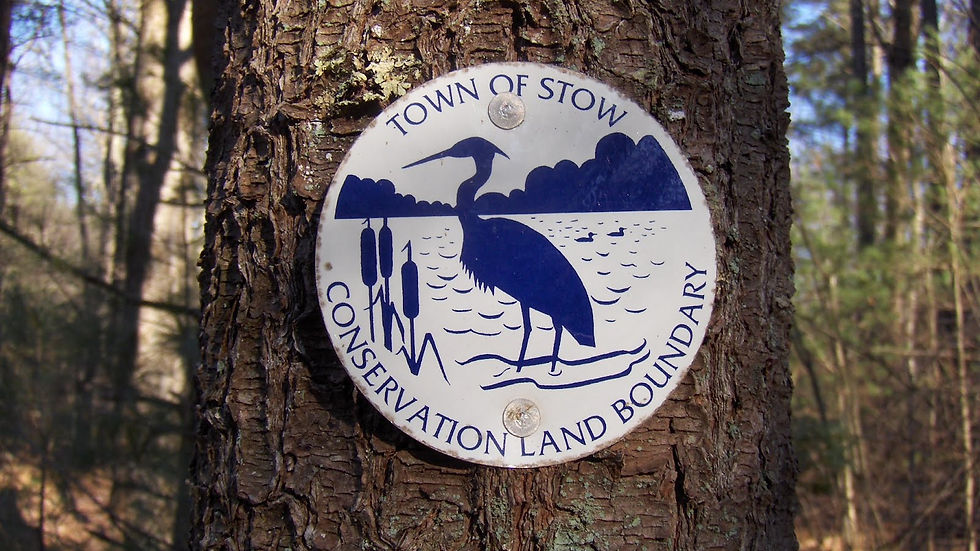
Stow residents have set aside close to 1,600 acres of town-owned conservation land. These are not leftover scraps. Places like Flagg Hill, Marble Hill, Captain Sargent, and the Town Forest have parking and miles of marked trails, so the land is genuinely used, not just fenced off.
The town has also been deliberate about keeping working farmland working. In 2017, Town Meeting voted to spend $1.4 million in Community Preservation funds on a permanent conservation restriction covering about 78 acres at Carver Hill Orchards. In December 2021, the town and the Stow Conservation Trust permanently protected the 151-acre South Course at Stow Acres, the parcel between Randall Road and the Assabet River, with a public trail planned around its perimeter.
Layered on top of all this is the Assabet River National Wildlife Refuge, 2,357 acres spread across Stow, Sudbury, Maynard, and Hudson, with roughly 15 miles of trails and 7.5 miles open to biking.
What Protected Open Space Does to Value
Here is the part that matters if you are buying or selling. Permanently protected land cannot be developed, which means the views, quiet, and trail access near it are not temporary. A home that backs up to conservation land in many towns carries an unspoken risk that the woods will someday become a subdivision. In Stow, a meaningful share of that open space is locked in by restriction, so the privacy you pay for is the privacy you keep.
That permanence tends to support prices and shorten the time it takes the right buyer to fall in love. When I list a Stow home near trails or orchard land, I make sure the protection status is documented, because it is a real and provable feature, not a hopeful description.
For Homeowners Already Here
If you own in Stow, your proximity to protected land is an asset worth naming when you eventually sell. It is also worth confirming. Conservation maps change as new parcels come under restriction, and abutter status can affect everything from your sightlines to your resale story. I am happy to pull the current maps for any address and walk you through what is protected nearby and what it means.
Stow asks a little more in drive time than some of its neighbors. In return it gives you orchards in bloom, trails out your back door, and the confidence that the landscape you bought into will still be there in twenty years.
If Stow's quiet and open space are calling you, I would love to walk a few trails and a few listings with you.
Figures sourced from the Town of Stow (stow-ma.gov), the U.S. Fish & Wildlife Service, and Honey Pot Hill Orchards, June 2026. Data shifts quickly; reach out for current numbers on a specific home or neighborhood.