Wayland's Historic Homes in 2026
- Jun 16
- 3 min read
A Heartwood Collective hyperlocal market note - Wayland, Massachusetts
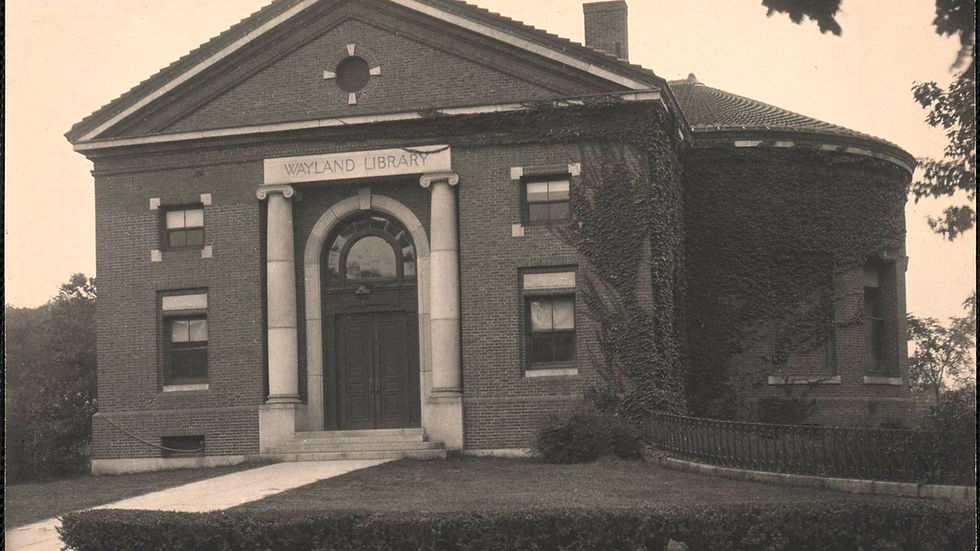
There's a stretch of Route 20 where Wayland Center sits almost exactly as it did 175 years ago. Fifteen buildings, most of them built before 1850, Federal and Greek Revival, wood-framed, a couple of old barns still standing. It's considered one of the best-preserved 19th-century village centers anywhere near Boston. I drive through it constantly, and it still makes me slow down.
Wayland wears its history more plainly than its neighbors, and that history shapes what it's like to own a home here. So this one is for the people who already live in an old Wayland house, the ones thinking about buying one, and the ones wondering whether all that character comes with a catch.
A town that invented the public library
Wayland was East Sudbury until 1835, when it took the name of Francis Wayland, a Brown University president and library champion. The name fit. In 1850 the town opened the Wayland Free Public Library, the first free public library in Massachusetts and the second in the country. A local representative, Rev. John Wight, then carried the idea to the State House, and the 1851 Library Act made it legal statewide to fund libraries with public money. The thing you take for granted in every Massachusetts town started here.
That civic streak is still visible in the housing. Wayland Center and the Bow Road district just north of it are protected as local historic districts, which means the antique homes there aren't going anywhere, and changes to them are reviewed. Down in Cochituate, the old shoe-manufacturing village, you find a different and slightly humbler housing stock built for the immigrant workers who powered that industry in the mid-1800s.
What owning the history actually means
An antique home is a real relationship, not a backdrop. Federal and Greek Revival houses were built beautifully and built differently: plaster walls, wide-board floors, chimneys that anchor the whole structure. If you own one, your maintenance calendar looks nothing like a 1990s colonial's, and that's worth budgeting for honestly. If you're buying one inside a historic district, know that exterior changes may need approval before you start.
None of that is a reason to walk away. It's a reason to go in with clear eyes and the right inspector. The buyers who are happiest in these homes are the ones who wanted the history in the first place, not the ones who got surprised by it.
Where the market sits right now
Wayland is not a quiet market. The median sale price reached about $1.4 million this spring, up roughly 11 percent year over year, with homes moving in a median of around three weeks. Inventory is thin, near eleven listings recently, down sharply from a year ago. For sellers of well-kept historic homes, that scarcity is a real advantage. For buyers, it means being ready to move when the right antique comes up, because it won't sit.
If you own a piece of Wayland's history, or you're ready to, I'd love to walk the town with you and talk through what it really takes.
Market figures sourced from Patch, Redfin, and Zillow; town history from the Town of Wayland and Wayland Free Public Library, June 2026. Data shifts quickly; reach out for current numbers on a specific home or neighborhood.